

As a film within the evolving Klapisch oeuvre, what La Venue de l’Avenir (2025) looks forward toward remains, of course, to be seen. As a capstone at this point in a now extensive career, though, this bountiful film clearly looks back to many of the director’s thematic concerns and harkens to narrative turns favored throughout: travel swinging wide the doors of a sentimental education, settling an inheritance to clarify both where one’s from and where one’s going, the aesthetic shock of the new, departure and return, the yearned-for complement of the other, the layered history and the utter freshness of Paris, family and community in all their senses. This is the consequential baggage borne so lightly in La Venue and the handful of previous films that, together with it, constitute Klapisch’s most lasting work.
* * *
In a career of three-plus vigorous decades with no sign of deceleration, Cédric Klapisch has written and directed 15 feature-length films, as well as an eclectic range of short subjects, documentaries, series, opera, and other productions. Never a darling of Cannes, at times bristlingly at odds with a certain French critical elite, he has consistently championed what Pascale Ferran in 2007 publicly dubbed a cinéma du milieu, mid-budget films d’auteur aligning popular appeal and aesthetic ambition. Few creative journeys actually begin with a sharply defined epiphany, of course, but Klapisch’s double rejection by France’s leading film school and subsequent decision to study cinema at NYU certainly do frame his later career path in telling ways. Hands-on filmmaking in early ’80s New York, Woody Allen blurring drama and comedy, the New Hollywood still new: what better antidote to the reductive doctrines of a Nouvelle Vague – once startlingly new, since ossified – in a France never unwilling to theorize, and then theorize the result? Today a nouveau Klapisch is an event. In a mode at once “humanist, modern” and gently “political” (Lefevre), Klapisch has since 1992 generously addressed intertwined questions of personal and social identity in an ever-mutating world. Shambling in affect, modest, and warmly empathetic – if touchy when the moment demands – he is now a significant presence in the French cultural landscape.
Klapisch once approvingly quoted Truffaut to the effect that the best filmmakers always make the same film, later elaborating on continuities within his own work in conveniently economical terms: “I tell stories of unique and different individuals caught up in larger social units. That relationship, the person to the group, is at the heart of what I do” (“Riens”). Bearing this deceptively simple banner is an artist – one half-guesses Klapisch would prefer “craftsman” – shruggingly unafraid to break with the romantic code of the tortured or eccentric creative spirit. Drawn affectionately to a broadly recognizable range of human behaviors, congenitally “normal,” Klapisch has said that, like Georges Perec, his concern is the trains that don’t derail. Among others he has taken as subject a modern dance troupe, department store dynamics, and contemporary urban anomie, Barcelona study abroad, Burgundy winemakers, and the Bastille mobilized for a lost pet. Throughout, according to the French cultural weekly Télérama, a distinctive Klapisch charm presides, “an apparently casual, light, precise touch” in a cinema at once “sociable, loquacious, and humble” (“Riens”). What interests him are families, tribes, neighborhoods, cities, and the individuals who, in interlocking, similar, evolving ways and in patiently evoked time and space, compose them. In a rare foray into the heist genre, Klapisch neatly pulls off clock-ticking urban midnight bank vault suspense, but his heart’s more into what draws an unlikely civilian into a misfit gang of random screw-ups. To this, to all his stories, he brings a kind of candid openness and radical affection for striving, flawed human character.


L’Auberge Espagnole. Courtesy of cedric-klapisch.com
Some of Klapisch’s work is familiar internationally, first the shyly charming When the Cat’s Away, then the boisterous Spanish Apartment trilogy, while the several most recent efforts have regularly found foreign distribution. The remarks to follow will treat in some depth roughly half of the films, those having earned the most critical and popular success, and in the process examine the recurrence and refinement of certain themes, as well as what one might call a Klapisch manner. His is a widely varied body of narrative subject but one adhering scrupulously, it seems, to a single hybrid form, the dramatic comedy – with a breath more emphasis on the adjective than the noun. When Klapisch directed the initial episodes of the hit series Call My Agent! (and, a noted actor’s director, persuaded several big names to take part), he remembers fussing over the script to achieve something of that balance. Fully admiring their efficient “American” comic effect, “my contribution,” he says, “was to re-write certain scenes more credibly . . . insist on a greater realism of nuanced dialogue and situation” (Daragon). Marked by that empathetic realism warmly leavened with a touch of humor, the films stand comfortably alone yet also explicitly invite consideration as part of an emerging oeuvre – thematically, of course, but also through what any alert repeat viewer will recognize as recurring elements, such as repeated visual patterning, narrative chiming, and certain playful tics. And indeed, why, for example, the puns and wordplay in the titles of nearly every Klapisch film, or their director each time around insisting on an unobtrusive acting role? What’s with all the evidently significant dancing and running in his movies? Where is Klapisch going with the recurrent past and future historical framing of present generations? And why the fascination with literal framing, those significantly placed windows and split screens, or the visually superimposed gridwork patterns marking many credit and other sequences? There’s far more than these fanciful questions to this genial, abundant filmmaker, of course, but along the way teasing out some possible responses may help signpost the route he has taken as one of contemporary French cinema’s leading talents.
* * *
Human Capital
Klapisch was fast out of the gate. Riens du tout is still relatively unknown, but its shambolically charming, mildly political look at the believably quirky inner workings of an immense Parisian department store mustered nearly half a million spectators nationally in 1992, a decent tally for a young writer-director armed with little more than prior short subjects and some corporate video work. Le Peril Jeune sprinted along shortly after, its frenetic, bittersweet Parisian take on the teen movie hitching Fast Times at Ridgemont High to The Big Chill. Overnight the latter established Romain Duris as a star (and Klapisch compagnon de route), while confirming how, from the get-go. Klapisch’s gifts had been on full display: credibly evoked social and physical context, an easy knack with crowds and group dynamics, empathetically convivial character development, an ambient if never saccharine optimism. Not to mention a quality hinted at in the title of that début feature, the plural first word of Riens du tout untranslatably off-kiltering the idiomatic expression “nothing at all” into meanings akin to “little nothings from a larger whole.” And indeed there is something Seinfeldish occurring here and throughout Klapisch’s work, the insistence less on big events than on the human meaning of the cracks in between. That’s certainly the case in Chacun Cherche Son Chat, a micro-budget bijou of wispily beguiling storytelling and Klapisch’s true breakout film. He will have Duris back for a keenly observed supporting role, but the 1996 effort is Garance Clavel’s from delicately delightful beginning to end. It is wondrous to watch how much Klapisch makes of how little. This is about it: planning a vacation, fashion make-up artist Chloé needs someone to watch her kitty, finding the only willing candidate in aged cat lady Mme Renée. Except that, on return, little Gris-Gris has apparently escaped, which leads to much tramping of the neighborhood and a spontaneous mobilization of the local grandmothers. Finally good news: it turns out the cat was chez Mme Renée all along, trapped behind the appliances. On this frail narrative underpinning Klapisch builds an intermittently funny, quietly entrancing story of urban loneliness, desire, communal bonds, and a changing Paris.

More than serviceable, the English-language title When the Cat’s Away nonetheless lacks the atmospheric longing of the original, tongue-twisty like some timeless adage in its insistence that everyone’s looking for their cat. That’s life in the big city for many lonely young professionals like Chloé, and perhaps all the more so, signals Klapisch, in the underlying tension of a Bastille quartier gentrifying before her very eyes. The changes to the neighborhood are fully alive to the viewer, with its grannies hobbling off to the market together and its warm, tattered dives just hanging in there; meanwhile, old buildings are coming down, new shops springing up – including one from the protagonist’s pretentious, high fashion icon/nemesis boss. After some hilarious sight gag shorthand for her holiday getaway – our heroine leaving with her luggage, dunking in the sea, returning with her luggage: total 30 seconds! – Chloé will conduct two scattershot parallel quests, looking for Gris-Gris and, vaguely, looking for love. The first allies her with sweet and limited neighborhood character Jamel, who knows everybody and every alley, and who starts to take more of a shine to Chloé than she wants. For what that really is remains something of a mystery, she admits, sharing with her horny gay roommate – Olivier Py in an exuberant comic turn – that maybe she chose their living arrangement because of that confusion.
But in French as in English, “cat” nevertheless has its sexual connotations, so, features drawn and Gris-Gris still on the lam, why not give it a try, dolling up for a night on the Rue de Lappe. Nothing doing there beyond some annoying harassment, and little more in a disappointing tryst with the Duris character, a dreadlocked cutie she wrongly thinks has long had his eye on her and not on every girl in the street. Yet from this moment, Chloé’s morale at its sagging low, Klapisch will turn the narrative dial delicately toward the film’s modestly giddy resolution. In the context of a distraught Mme Renée marshalling the concerned busybody neighbor ladies for the lost feline, Gris-Gris’s meowing reappearance registers less as gatta ex machina than sudden, sweet collective reward. Chloé’s parallel search will end in similar satisfaction but only by the quietest accumulation of storytelling detail and nuanced performance. In the loud nearby cafes still resisting the gentrification agenda, we’ve periodically met the local crew, playfully ragging Jamel, flirting for comic effect, half-interested in the cat news. One of the recurring faces is nice enough, barely noticed Bel Canto who, it turns out, lives upstairs across the hall and is now moving out. Hearing the racket, Chloé asks if she can help and, for ten minutes of exceptional cinematic charm – look imperceptively becoming held look becoming shared load down the stairs – the indefinable magic of personal attraction asserts its invisible sway. When it’s time for the truck to pull away, Bel Canto and Chloé can’t quite withdraw from their mutually grateful farewell embraces. The two finally exchange numbers, the truck leaves, the film ends with Chloé, infused with a new life force, running down the street in a believable élan of joy kilometers from rom-com predictability.


Chacun Cherche Son Chat. Courtesy of cedric-klapisch.com
That the love interest was all along hiding in plain sight fits this neighborhood in the 11th arrondissement of Paris. A ten-minute walk will conduct you to the site of every scene in the film. Thoreau said that it takes a genius to be a tourist in one’s own neighborhood, and Klapisch accordingly films the Bastille with an attentive affection open to the faint magic of the everyday, that place where black mechanics crinkle with shared laughter to hear the lost cat named “Gray-Gray” is black and Chloé, in the showy new boutique of the snobby boss looking down her nose, stoutly identifies a raggedy pack of old cat ladies as her pals. In this the third of Klapisch’s films set in Paris – and they’re not stopping here – place plays a starring role, as it will, famously, just a few years later in Jean-Pierre Jeunet’s Le Fabuleux Destin d’Amélie Poulain. Both tell contemporary stories of feminine urban solitude and longing, and in both the eventual object of affection is, like Gris-Gris, there all along. Less lushly nostalgic than the Jeunet film with its overheated color palette and throbbing Montmartre of the heart, Chacun Cherche Son Chat still quietly idealizes a Paris seen as vanishing, a place with, essentially, more time for the human. That both films sing mini-hymns to the yearning for solidarity and personal connection speaks to an implicit fear of loss one can with little difficulty identify as the residue of deep changes already sensed in post-industrial France, then heightened in turn by ’90s millennial anxiety.
While Klapisch’s breathless 1990s will also include a sharply staged version of a hit Jaoui/Bacri play about filial and parental relations and Peut-être, an oddball time-travel paean to solidarity across the generations, Chacun Cherche Son Chat most memorably enacts this yearning so recurrent in his work, the contemporary individual’s search for what one could perhaps most simply call family. In his second decade of work the Parisian native will take that hunt beyond a transforming Bastille to the scale of an eponymous Paris (2008), and then further still, in the bracingly moving peregrinations of the Auberge Espagnole trilogy (2002- 2013), to Barcelona, Moscow, London, and New York. Always busy, during this period he’d as well take the heist formula out for a forgettable spin, then somewhat simplistically address a dehumanizing late capitalism in his most overtly political film, My Piece of the Pie, but it’s the trilogy and the 2008 Paris that most solidly enhanced Klapisch’s critical and popular standing in the first years of the new century. The very title Paris suggests something of the film’s extensive range and ambition. And from the opening shot – the capital spread vastly out before the viewer – the French capital itself plays very much a central character in the narrative to follow. One thinks of Fellini, Altman, Woody Allen, of Joyce, Balzac, and, directly hailed by one of the film’s central characters, Baudelaire.

Like Riens du Tout a “film choral,” or ensemble piece, Paris follows a number of representative individuals and groups in their daily professional, family, and love lives. Across the shared, attentively portrayed geography of Paris there’s the casually racist boulangère, the social worker better at helping others than herself, the chic models and the African migrant, the architect brother who does everything right, the band of roughnecks working out of the sprawling Parisian wholesale food market, etc. Into this emblematic variety, Klapisch further introduces two characters whose perceptions help draw its disparate forces and desires, its loves and losses, into a certain focus, a dying performer and a university professor wracked by mid-life crisis. In this film very much about the act of looking, Romain Duris’s Pierre is used to being watched himself as a nightspot revue dancer, but is now reduced by a terminal cardiac ailment to sitting at his rear window. While the Hitchcock evocation’s as clear here as in Klapisch’s recurrent cameos, the charmingly erudite Sorbonne professor Roland might as likely reference Mallarmé’s “Les Fenêtres,” about an aging invalid enviously gazing out the eponymous windows on a vibrant world. In any case, both Pierre and Roland are locked in private dramas, the meanings of which will help inform those of a film trying fearlessly to get its affectionate arms around the Paris that King Francis I once famously called not a city but a world.
An irresistible Fabrice Luchini plays middle-aged Roland, a specialist in Parisian history juggling two temptations, both touching intimately on the passage of time: whether to accept the big euros and dumb down his highbrow historical research for a TV audience, and what to do about that ineffably beautiful, and much younger, grad student he’s been flirting with. While he will yield at last to both, his first fumbling attempts at seduction often reduce to middle school ineptitude and provide some of the cringingly funniest moments of this typically dramatic/comic Klapisch blend. Meanwhile, expounding eloquently on a telling parallel between the city of Paris and the work of Baudelaire, the serious scholar Roland will also provide some self-reflexively pertinent clues to the filmmaker’s method. The poet’s famous preface to Le Spleen de Paris speaks of a jumbled entity with “neither tail nor head,” an image directly addressing the fragmented storytelling of a film telling a dozen separately individualized stories that, like life or Baudelaire’s modernist poetic innovation, seem just to happen, sometimes intersecting and sometimes not, by moments speaking of shared meanings, at others the hazards of fortune. Yet at the same time the professor’s warm evocation of Baudelaire can’t help but also recall his differently famous Tableaux Parisiens, an ordered series of poetic sketches compassionately portraying varied categories of people encountered in the capital’s streets (the blind, the beggar, etc.). While critics have taken Klapisch’s film occasionally to task for caricaturally reducing characters to their professions, the filmmaker drawn temperamentally to aesthetic values shared with the innovative 19th century (e.g., Zola in his first film, Nadar and Monet is his most recent) may well be exploring in his way the larger century-long Tableaux and Physionomies traditions of portraits intended to represent certain classic Parisian types and scenes. And what if, finally, both things were true of Paris, that it tells of a sprinkling of distinctive individuals across a city and that it tells the story of a city itself through meaningful pattern and generalization? The answer might lie in, again, Klapisch’s own words, “That relationship, the person to the group, is at the heart of what I do.”


Cédric Klapisch in Paris. Courtesy of cedric-klapisch.com
For an illustration, look no further than the adorable scene in which the professor, at last beyond hungry staring, finds himself alone with his now willing young friend. She puts on Wilson Pickett’s “Land of a 1000 Dances” to which, taken by sheer joy, ridiculous and touching, he does the Pony like Bony Maronie. As throughout Klapisch, where cutting a rug and musical performances are significantly common occurrences, dancing here figures the successful integration of individual and communal action, an élan of uniquely personal energy in the moment framed by history’s guided steps. And meanwhile, speaking of framing, through his window danseur Pierre looks impotently out on Paris with its thousands of dances, including at one point the return steps of Roland’s new love interest to her nearby apartment and, soon, fervent reunion with her real boyfriend. Resisting death in a near future even as the professor struggles to reclaim the past, Pierre presides over a city where, as for us all, individuals are both living intensely and only passing through. Klapisch shuttles affectionately amongst his varied characters, with their lost loves and new encounters, the boulangère grudgingly accepting the North African gal’s her best employee, two brothers at a father’s funeral, an utterly random accident. With the embarrassing exception of some top fashion models who traipse absurdly out to Rungis to dally with the butchers – presumably to illustrate social classes meeting, or something – these convincingly interlaced tales draw the viewer humanly into their intimate dramas. While there, both above the action and fully part of it, Pierre cycles through something like the stages of grief, depressed, angry, nostalgic, yet also curiously inventing tales about the fragments of life glimpsed through his rear window. Here with a few touches Klapisch also paints a delicate portrait of Pierre and his generous, lost sister (Juliette Binoche, luminously convincing), as each slowly coaxes the other back toward tentative engagement with life.
En route Klapisch repeatedly displays his gift for the quietly resonant cinematic image. Midway through the necessarily fractured narrative, he returns to the opening scene sweep of Paris to reveal the view as that of a lovesick Roland, texting and phoning from the Eiffel Tower. Looking idly south, he just makes out a dusty cloud floating off the Tour Montparnasse, unaware, of course, that it’s the scattered ashes from a separate narrative; to the north sits Sacré Coeur where he, of course, can’t see his student snuggling her boyfriend before quickly checking the screen and flipping off the phone. Across this shared space lives saddened, yearning, blissful; lives simultaneous, interwoven, separate. And in another example of the film’s discreet visual shorthand for such reflections, two Beckettian workers gabbily strolling alongside the railway glance at the snarled mass of uncountable electric lines appearing from the tunnel behind and disappearing into the next, then for an instant absently muse about where they’re all from and where they’re heading.
As the guys then go on about everything and nothing, the image is left to do its thematic work, with no explicit follow-up, that is, until perhaps the silent last instants of the film’s brilliant conclusion. As it rounds to that point, Pierre has received a mysteriously pressing call one soon enough guesses signals the availability of a heart transplant. Finally getting someone to watch his sister’s kids, central to the generational therapy at least partially hoisting him from the dumps, he calls a taxi that, no surprise, soon enough finds itself mired in traffic as the clock mercilessly ticks. Of course, the driver does what’s expected, complain, but as the cars start moving again, Pierre’s voiceover does the opposite, quietly marveling at those alive on the streets of Paris blissfully unaware of how happy they should be to be alive on the streets of Paris. It’s not corny, only right that he passes the never-met migrant looking for directions or a never-met Roland meditatively ambling down the avenue, for they and their endless like are the never-met cast of walk-ons in each of our films. His taxi dancing from neighborhood to neighborhood, the flaneur looks out on the city and its denizens with a generous appreciation sharpened by his foreshortened perspective until, camera shot gracefully withdrawing, silently widening, the car leaves the capital’s streets for the freeway and disappears in the hopeful, hopeless tangle of other lanes.
* * *
European Unions
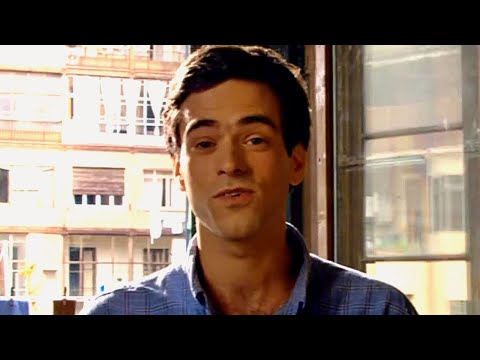
To its humanist auteur, that tangle is the thing. It’s at the heart of this, one of Klapisch’s most mature and significant films, just as it will act as the driving thematic force of the concurrent, ambitiously overarching project of l’Auberge Espagnole and its two sequels. And it’s very Klapisch that this will be the case even as the narrative of the latter will energetically propel its Romain Duris-incarnated protagonist along a life trajectory opposite to that of Paris. In l’Auberge Espagnole, young, his life fully in front of him, plus confused by a competing desire to write, Xavier Rousseau’s a university student led to understand he can best ride his family connections directly into the French Finance Ministry if he knows the Spanish market and better commands the language. So it’s off to enroll in the famous Erasmus exchange program, the brilliantly successful international collaboration that has since the 1980s sent millions of European students abroad to institutions throughout the continent. For the protagonist that means a year in Barcelona and, after some tough apartment hunting, an invitation to share a place with a half dozen students of varied nationalities. All this comes through the eyes and frequent voiceover of Xavier, the inevitable Duris at his enthusiastic, charm-cut-by-a-dash-of-smarm, bemused, stylishly unkempt best, who will plunge joyfully into the experience, make friends to last a trilogy, and, in the end, fully embrace the vocation that sets the present-day character up typing at a screen and storytelling from the film’s opening to closing minutes.
Certainly part of the movie’s and its sequels’ robust success lies in the timing, just after the hopeful ’90s with the Berlin Wall no more and Brexit still a decade and a half off. The microcosm for this upbeat moment of European unification is that joyfully chaotic student apartment, Klapisch’s “Spanish Auberge,” a French term for a haven to which individual guests bring pot luck, whatever they have. In that space an emerging sense of unity chimes with flourishing individual difference – a Europe not of fakey Esperanto uniformity, one more like the Belgium of Xavier’s soon-to-be-pal Isabelle, pleased not to have to choose between Flemish and French identity. Bono’s famous terms are one but not the same. Putting all these smart young people together with their different languages, cultures, and separately timed fridge leftovers, the veteran of such a scene during his own New York days shares the ways international study feels. Throughout, the film communicates the shimmering aliveness of walking the foreign avenue one finally calls home or how helpless dismay by steps becomes confident mastery. There, in Xavier’s sentimental education, the rare subtraction of a breakup with uptight girlfriend Martine pales alongside the additions, those myriad daily appropriations of the once incomprehensible, with friends become near-family now scattered throughout Europe and the world.

Following L’Auberge Espagnole with the 2005 Les Poupées Russes (Russian Dolls) and 2013’s Casse-Tête Chinois (Chinese Puzzle), Klapisch will for more than a decade accompany Xavier’s misguided trajectories and happy course corrections, as his gently comic, haplessly charming protagonist-narrator, still close to those friends, pursues a halting writing career and a series of short- and long-term relationships from Paris to Manhattan’s Chinatown. Taken together as their character and plot lines urge, the three films are the signal achievement of this period – and, arguably, Klapisch’s oeuvre – but their standout is clearly Les Poupées Russes. Having sent Xavier off to Barcelona, the writer-director created what many younger French viewers considered a film générationnel. But like all of us the Duris character would grow up, and Klapisch smartly recognized the cinematic potential of increasing age, with its more complex questionings and weightier responsibilities. The first film’s a deservedly popular take on the bildungsroman form and an enthusiastic examination of personal discovery but finally a thinner, simpler experience than its successor. What the two clearly do share, though, is a series of thematic concerns visually announced in their credits and their supple, manifold use of a particular image and its variants. As in Auberge and nearly all of Klapisch’s films, an exceptionally lively opening sequence structures itself around recurrent rectangular framing, checkerboard squares. and multiplying split screens, a visual concern often echoed throughout the narrative to follow, with, again, more ’70s-like split screens, prominently echoed windowpanes, framed artworks, photos, etc. While such imagery can at times serve as an emblem of cold uniformity and isolation, more often in Klapisch it suggests the opposite, a promising – if correctly acted on – rapport between individual and community, that of a meaningful, patiently constructed human mosaic. In the closing scenes of the first film, Xavier evokes that image with photos of his friends lovingly arrayed on the floor and with the rectangular computer screen now become a vital tool of connection for the aspiring young writer.
Coming along three years later, Les Poupées Russes begins much as the earlier tale left off, with the now committed writer at his screen musing about word choice while hurtling across Europe on a TGV. The voiceover’s back, and the act of storytelling, a pleasant framing before, is now very much the subject at hand: the stories we tell ourselves, their illusory or not happy endings, and the tempting compromises of the working writer, in particular this one who can’t find a publisher for his book L’Auberge Espagnole, who’s ghostwriting celebrity bios, and who accepts an offer for hackwork on a syrupy TV series. From the beginning, Klapisch, his cameo this time a stranger on a train, announces that the storytelling in question is also of the cinematic kind, with a first train roaring up as if into the La Ciotat station, and others, appropriate to the larger tale of Xavier’s love life, flying into tunnels on their North by Northwest trajectories.
A love story initiated with an offbeat nod to Shakespeare – boy on balcony, girl below – is what gets things going here. William, the once-boorish brother of Xavier’s English friend Wendy, has brought the Barcelona crew together in St. Petersburg for his wedding with a Russian ballerina, the groom and the location proof, Klapisch suggests, that, the past past, growth is possible. Posing for a group photo, Xavier pauses to ask how all this came about, which sets his fractured narrative off like the mobile mosaic fragments of the director’s recurrent credits design. Xavier’s slim bank account has led him to accept what pen-for-hire work’s available, and much of the comedy of this often very funny movie comes in the enactment of his imagined bouts with the saccharine storytelling required for a soap opera paycheck. Time has passed since Barcelona, but Xavier remains close with familiar characters, notably ex-girlfriend Martine, now a more relaxed single mother and surprising confidante, wry and solid Isabelle who will find room in a parade of girlfriends to put him up for a stretch, and sweet Wendy, in London mixed up, as usual, with the wrong guy. Again, the narrative turns to the theme of fiction as Xavier reads fairy tales to Martine’s son and, for his curious grandfather, spins a backstory passing a comically uncomfortable Isabelle off as his flame. When Love and Passion in Venice gets picked up as a BBC co-production, Xavier half-moves in with Wendy to co-write the English adaptation, and storytelling remains very much the issue. Illustrations she draws on include Scheherazade and The 1001 Nights and Pinter’s Betrayal, both sets of interwoven narratives and stories within stories set in a context of love and deception.


Les Poupées Russes. Courtesy of cedric-klapisch.com
The Xavier who, always holding out for the unattainable, can’t seem to make it work in his cluttered love life finds himself over time drawing closer to Wendy, even as a parallel gig ghostwriting the autobiography of a stunning model leads to Paris and, eventually, her bed. After a triumphant night, a hilarious stretch of magical realism sets him astride a fairy tale white horse galloping on the Ile St Louis. Yet, despite the model’s temporary dazzle, the mutual attraction with Wendy becomes inarguably stronger as, gently flirting, they debate the hokeyness or not of the proposed screenplay line “I’ve always loved you.” If you don’t know where this is going, you’re not paying attention. It may take some muscle to show Wendy’s abusive boyfriend the door, but the rom-com fans who know Kelly Reilly from the Jane Austen original of the genre, Pride and Prejudice, will find their expectations amply rewarded as she and Duris bring warmly adult chemistry to their characters’ long-awaited, believably affectionate relationship. And then, at last, it’s back to St. Petersburg and the wedding. There the William-Natasha romance is certainly not Klapisch at his most convincing, reading at times like a simple pretext for later use of the Russian Dolls metaphor. But like the reunited Barcelona gang that at times functions as little more than colorful extras, this is all just a pleasant, sometimes comic backdrop, for what matters to the viewer is the developing tale of Wendy and Xavier. In which, of course, complications ensue, again in the shapely form of model Celia, calling from a shoot in Moscow to tempt her favorite writing partner away for a few days. Torn but accepting, Xavier lies unconvincingly to Wendy, who, knowing her Pinter, will keep her counsel and accompany him to the train. Their five minutes in the beautiful St. Petersburg station constitute one of the great scenes in recent French cinema. Sadly winsome in her aching sincerity, Wendy declares her love for the “perfect guy” Xavier, the adjective not as he, fumbling guiltily for words, first understands it but rather in the sense of the perfectly human, flawed and real in loved imperfection. On the gorgeously shadow-lit platform, she walks away, slowly and then more quickly, utterly there aside a leaving train and utterly elsewhere sheathed in the dreamlike chords of Beth Gibbons’s “Mysteries.”
That mysterious tension between reality and dream drives Les Poupées Russes. Xavier will get another dose in Moscow with the Celia of faultless proportions only dreamt of – yet, like the ideal symmetry of the St. Petersburg street Xavier visits, can you really live there? Her inevitable response is literally to love him and leave him. Back tensely at the wedding, the narrative bouncing about as Xavier reflects on the nature of affection and desire, Wendy’s estranged parents quarrel while the harmonic energy of the dance prepares a welcome moment of reconciliation. The screenwriting tandem had it wrong all along, for there is a time, now, for “I’ve always loved you.” Yet if she looks sad, Wendy says, “it’s because of my parents. I’m afraid of what’s ahead of us.” In a voiceover then bridging toward a closing scene of soothing domestic tranquility, Xavier will evoke the film’s title, explaining how the search for love leads you to keep opening each of the many dolls nested inside the previous, obliged to continue time after time until the one you think might finally be the last.
This seems to be the case when the film sweetly closes. As Wendy places the last piece in the vast jigsaw puzzle on which she has been working, she announces in French, “J’ai fini,” to which Xavier responds, “Super bueno.” This is super gratifying Erasmus-veteran closure, to be sure, but Klapisch also asks that we look more carefully. The puzzle itself speaks to the slow unification of a thousand shattered pieces, imagery recalling the scattered checkerboard squares of Klapisch’s credits and elsewhere, Xavier’s satisfying photo mosaic in the previous film, or for that matter the assembled fragments of Europe backgrounding the trilogy. Even more pertinently, however, it calls to mind the healing process, a healthy whole at last achieved but with, like the puzzle’s composite pieces, the scars still showing. Significantly as well, Wendy’s puzzle recreates Edward Blair Leighton’s Neo-Raphaelite extravaganza The Accolade, a painting lushly portraying Guinevere’s knighting of Lancelot. Here we return to myth and the impossible ideal, to savored fairy tales and Xavier’s white steed. Yet is there a snake in this garden? The Arthurian saga sings of an ideal Camelot, but the principals of the painting, we know, whisper of possible betrayals to come.

Of course they do, for Klapisch is treating the complications of adult life and its participants’ necessary adaptations, feints, and compromises. If anything, this is even more apropos five years later when he brings the gang together anew for Casse-tête Chinois, or Chinese Puzzle. Once more playfully significant, the title returns thematically to the challenge of assembling countless intricate, confusingly related pieces while alluding to a key destination in an again itinerant film, in this case New York’s Chinatown – even if, per the other films, Xavier’s comfortable voiceover sets it more relevantly in his head, heart, and loins. In this flamboyantly loose-limbed enterprise, one submitting with difficulty to any kind of vaguely succinct summary, suffice it to say that Wendy and Xavier are divorced, that she lives with her future American husband in New York, and that he moves there from Paris to be close to the kids. In no particular order, throw in sperm donorship to buddy Isabelle and her new partner, a marriage of convenience, hysterical guest numbers by Schopenhauer and Hegel, and, no surprise, Xavier struggling with a novel. There’s also a new/old love interest in the form of Audrey Tautou’s Martine, a character tracing a strained but fascinating arc in the three films. In the first, the girlfriend left behind, she’s a stiffly homegrown française not designed for export like her boyfriend’s new Barcelona crew; unsurprisingly she and the increasingly cosmopolitan Xavier part ways at the end of L’Auberge Espagnole. In Les Poupées Russes, just friends, he remains complicit with a cooler, now funnier Martine who, among other things, leaves her son with him while she heads comfortably abroad for an environmental conference. In the final film, Klapisch sends Martine to New York where, en route to China on business, she continues to surprise her ex, chatting away in Mandarin and, Xavier finds with delighted exhaustion, displaying a fresh, much more experimental attitude toward lovemaking. Why can’t a person change?, she asks with moving simplicity, a question solidly in the wheelhouse of this romantic auteur – romantic not in the rosewater sense but rather that of the long philosophical tradition announced from the trilogy’s beginning in the family name of the Duris character, Rousseau. Over three films forever enshrining him in the French film canon, Xavier memorably enacts that romantic vision in a life of addition and exploration unfailingly open – for all its multiple failings – to human possibility, growth, and change.
* * *
Time Share
Aside from his role as patriarch in the trilogy’s 2023 series sequel, this will, unsurprisingly, be Duris’s swan song as a Klapisch regular, naturally aging out of a cinematic vision largely turned to the stuff of relative youth, change, and the search for a meaningful place in a larger world. These are certainly high among the stakes in the 2017 Ce Qui Nous Lie and its three siblings brought together by the illness and death of a dominant father. As the international title Back to Burgundy signals, the action takes place in a traditional family vineyard, its rituals and yearly rhythms observed by Klapisch with detailed, loving attention. Appropriately in a film paced by those rhythms, the lovely credits sequence features the changing seasons in ravishing time lapse, each year different but the same, the stunning immediacy of color dancing in place with timeless return. Providing the warm, reflective voiceover so often featured in Klapisch’s work, eldest son Jean begins by examining versions of that tension. In that place where everything and nothing changed, there were the same old quarrels with father, so he had to find something new and see the world – yet “leaving to escape him, now I’m back because of him.” Recalling Chloé’s vacation sight gag in When the Cat’s Away, Jean strides out the domaine archway, with, ten seconds and ten years later, the image reversing to his striding return. There in the courtyard of coming and going hangs the old rope swing of childhood, a delicate emblem of merged movement and stasis from a filmmaker with an eye for the thematically expressive image. As for Jean’s return, it’s about time, with the legacy of the vineyard leadership and each day’s lot of decisions on the line. Only, while Jean’s been off in Australia with a now-estranged wife and child creating a vineyard thrice the size of the family operation (if minuscule by standards down under), sister Juliette and the youngest, Jérémie, have been hard at work; and, more essentially, if Jean had bothered to call, he’d have known Maman passed away five years earlier.

In this shared family space, against this sharply lit emotional backdrop, brothers and sister will work through their pasts and their imagined futures while tending to daily questions as concrete as the optimal moment to begin the harvest or whether to go with a 70/30 or 50/50 blend. To resolve those issues is necessarily to take a stand with regard to their father and the weighty heritage of the past and his uncontestable choices. Klapisch’s method is to shuttle back to a series of childhood memories, like, say, learning blindfolded to taste grapes, while placing his protagonists as much as possible in the gorgeously filmed rows of vines. In one of the many tableaux of the three siblings together, a beautifully staged shot among the rich leaves, Juliette rises up as if born from them, followed by Jean rising similarly, leaving Jérémie – who, not coincidentally, we will find is the least naturally gifted winemaker of the three – walking into the row from the left. Amongst the three by virtue of age, Jean at first is granted legitimacy until it eventually becomes clear to all that the real talent, the true héritière, is Juliette. This will be clear after their father passes away, but in the meantime the three sit in a textured moment of reconciliation, drinking old wine with the employees and remembering that first taste of the 1990. A central plot conflict soon follows, however, in the inevitability of an imposing inheritance tax. In a neatly observed rendering of a certain accurate slice of French life, the notaire informs them of a debt of half a million euros. Now how to pay: sell the wine stocks, sell certain parcels, sell the house, or sell it all, as Jean, who has another life, and wants to clear out, urges? To this the narrative then grafts a secondary complication in the form of young Jérémie’s in-laws, in particular his wife’s father, a neighboring winemaker with an overbearing nature and the ready cash to snap up some of the best parcels should the kids be persuaded to sell.
The seasons changing as they do, resolution comes largely in the form of Jean’s evolution. Though he’d kept it to himself, he had seen his father and discovered the unsent letter of unsaid encouragement, and the land exerts its hold. He had forgotten how it never ends, caring for the land until “we think it belongs to us, but in fact we belong to it.” As in his reflections opening the film, the ready chiasmus might seem tidy, but it’s the appropriate figure for this world that contends that things change constantly, then argues they never do, where, as he says, “in one year nothing had changed, but I had.” Following Juliette’s intervention bringing Jean’s wife and son to Burgundy, the couple reconciles, and he is able to see his return to a father become discovery of a family here and in another part of the world. With a solution selling the house, the family keeps its land, and, seasonal return the rule, Juliette’s scene briefing the harvesting team precisely echoes the same moment from early in the film, and finally Jean leaves again through the archway. In typical Klapisch fashion, the title speaks obliquely to such questions of memory, process, and change raised by the film. “That Which Links Us” is the direct translation, yet the choice of the verb “lie” also clearly evokes the deposit left in wine after its fermentation, in some ways the memory of that very process of transformation. Not only a more than appropriate verbal nod, this is as well still more proof of an affectionately industrious filmmaker at work, one who has truly observed, thought about his subject, and put in the time. For the family narrative at the heart of this generous, moving film only truly works with full immersion in a deeply understood professional world. Klapisch has spoken about making that effort, and it shows from something as simple as Juliette’s throwaway line when facing the possibility of selling off the domaine’s best parcels. “I don’t want to be the queen of aligoté,” she protests. That no explanation accompanies her mention of an inferior grape variety used for unexceptional white wine – something few moviegoers, even in France, will pick up on – is to Klapisch’s credit, for he is out to portray a real world, come what may. The film smells, tastes, and feels like French winemaking, and the insider reflections on harvest dates, sunny slopes, French law, invasive neighbors, and the intricately divided, often row-by-row holdings in Burgundy are nothing if not respectful to viewers too often accustomed to a dumbing-down of “background” details for wider consumption.


Ce Qui Nous Lie. Courtesy of cedric-klapisch.com
Klapisch’s fidelity to the realities of the French vineyard extends to the essential ritual of the traditional post-harvest celebration bringing together everyone from field workers through the domaine owners and their families. Like the varied shots of the three siblings together, striking if more static, the great group scene benefits from the filmmaker’s signature attention. Klapisch’s formidable framing of crowd shots, he’s said, draws on the work of directors like Kurosawa and Fellini, capable of spontaneous, even chaotic effect in scenes that, because intelligently composed, remain intelligible to the viewer. In this rowdy, fetchingly warm set piece, effective mise-en-scene highlighting certain personal relationships within the push and swell of a Bruegelian group transitions casually into choreography as, in characteristic Klapisch fashion, individuals find themselves drawn into the clamoring, playful synch of dance.
Two years later the timed steps of a differently traditional form of dance will bring people together at the conclusion of a far different reflection on the individual-group dynamic. Starring Ana Girardot and François Civil, sister and younger brother in Back to Burgundy, Deux Moi moves from the comforting, limiting confinements of traditional rural life to spaces of contemporary urban isolation and the illusory freedom of its lonely multitudes. The setup’s not complicated. Mélanie is a bored research biologist, Rémy a dead-end cipher dully bouncing from call center to Amazon warehouse. Alone, depressed thirty-something Parisians, both will seek professional help. They live in drably adjoining apartment buildings but don’t know each other. Melancholy material, to be sure, but just as surely the makings of romantic comedy (as the sugary international title Someone, Somewhere more than hints). Deux Moi is a daringly simple play on this irresistible narrative tease by a writer/director refreshingly unafraid to please. At the end of the period punningly indicated in the title, of course they will meet, and very gratifyingly so. But what precedes is less the pretexts and contrived false starts of rom-com convention than a deft blend of character development, serious questioning about personal solitude, and interludes of laugh-out-loud humor.

Released in 2019, Deux Moi is also an eerily accurate foreshadowing of the pandemic isolation just over the horizon, with its prescient versions of sheltering in place and social distancing. Almost as a kind of taunt, the film is set in the long shadows of Sacré Coeur, not in the nostalgic glow of Amélie Poulain whose story of lonely doings in Montmartre it otherwise glances gently off, but in the colder, less visually satisfying reaches of the 18th, with their colorless architecture and desolate Gare du Nord train lines. If its fidelity to an uninspiring Parisian quartier, spindly plot details, and solitary questing after the other recall Chacun Cherche Son Chat from two decades before, that is surely no accident, for Klapisch even throws in a Mme Renée cameo, not to mention a red herring white cat. Like Chloé, the two protagonists are on the lookout but here in a more bluntly numb manner, for Klapisch seems to be looking beyond the contemporary hyperconnected solitude of these characters to deeper personal issues of fraught family history and self-acceptance. He thus sends each off to a shrink for sessions of psychoanalysis, which, sketch versions that they admittedly are, nevertheless convince despite the broad comedy target such cinematic moments often engender. This is largely due to quality performances by Camille Cottin and François Berléand, who, between only the sweetest of humorous swipes at their characters’ profession, consistently communicate generosity in their gentle probing and sincere attention to patients needing achingly to recover a moi before even discussing a nous. That said, the maladroit reaching out by Rémy and Mélanie jerks along by fits and starts, often to sidesplitting effect, such as the latter’s app hookup with a self-absorbed, street-pretty bonehead having strictly zero to say beyond a white-hot “I feel like I’ve been looking for you for years.” Between panic attacks, sleepless nights, and labradoodle blank stares at the HR guy, Rémy bumbles tragicomically through a date with a workplace co-drone. Later, trying to wring some form of contact from shared nostalgia, he meets up confusedly with a hilarious, almost unrecognizable Pierre Niney offering five minutes of hyperactive scene theft as that wildly stoked classmate from the distant past who vividly recalls details you never knew in the first place.
Despite these pro-forma encounters, for the film’s protagonists it’s mostly a game of solitaire. The first image offers terms for their plight, the biologist’s microscope framing countless individual cells on their incomprehensible individual cellular errands. Mélanie and Rémy mechanically walk the grey streets alone or sometimes unwittingly together, obliviously trudge into the same pharmacy, try variously to get to sleep or get out of bed, catch a whiff of cigarette smoke from the unknown other, or make out some music from the nearby apartment. In the meantime, with their respective families and therapists they do take two credibly incremental steps forward for each one back. While perhaps as important, we’ll see, are those daily steps taken by each into the neighborhood grocery, a Parisian classic seemingly the kingdom of Middle Eastern products but in fact selling everything you’d ever need. Klapisch stalwart Simon Abkarian plays shopkeeper Mansour as boisterously colorful, playfully upselling when he can and privy to all the local gossip; and, by the way, you should check this out, here’s a flyer for his brother-in-law’s weekend dance class. Unsurprisingly, with a sweet inevitability after their slowly earned parallel evolutions, Rémy and Mélanie make their separate ways to the hall where others are also arriving and the first moves of the seductively rhythmed African dance class are under way. Informal impresario Mansour introduces and pairs off the newcomers as he can, at last bringing together from opposing walls our two. The scene masterfully manages both sensual beauty and reserve, through the individual, coordinated moving forms, the camera advancing with slow subjectivity from Rémy toward Mélanie until their encounter, all tingling hesitancy and barely admitted mutual attraction. Then it’s only hands shyly touching, finding their relation, a lovely act of discretion on the part of Klapisch, who prefers to gaudy triumph the more than enough for these two that is just this first quiet loosening of the soul’s muscles.
In this delicately satisfying film, dance once again plays a determinant role. Whether or not this loosely confirms Beaumarchais’s famous pronouncement that everything in France ends in song remains to be seen, but for Klapisch’s next feature, the 2022 En Corps (Rise), music and dance are indisputably the raw material from glorious beginning to gratifying end. And glorious that start is, fifteen sumptuously shot minutes from the Ballet de l’Opera de Paris establishing the ineffable splendor of bodies utterly at one with themselves and others. Klapisch’s liberal use of screen time in this way is an audaciously winning choice, forcefully, seductively immersing the viewer in refinements of classical ballet that will serve as a lovely visual and aural after-impression complementing the alternate aesthetic universe piledriving the latter half of the film, contemporary dance in all its terrible beauty. With a paced montage of furtive backstage shots, that riveting opening sequence furthermore introduces the essential plot detail: Prima Ballerina Elise, distracted by a glimpse of her life partner’s infidelity, falls and brutally injures her ankle. From this point, career essentially over, she will kick aimlessly around, eventually working with friends in a Brittany food truck placing her in fortuitous contact with a resident contemporary dance troupe. Not unlike a sports movie with preparation sequences and the rest, the recovery narrative to follow is, of course, predictable. Oh, but en route, street music pounding time, the real deal is the dance and new life Elise awakens slowly to, that and the alien artistic communal space into which she at first shyly limps and where she at last finds a leading role and more.

In this, her first movie part, Marion Barbeau is a revelation as Elise. Star of the Paris Ballet from 2018 to 2024, she transforms seamlessly into completely credible offstage presences, but always with the innate/endlessly trained feline grace of the true dancer. Klapisch’s cinematic fondness for bodies swayed to music is familiar to any long-term viewer and, finally, unsurprising from the director of an acclaimed documentary on danseuse étoile Aurélie Dupont as well as a 2023 Parisian production of Mozart’s La Flute Enchantée. To this add a broader fascination with the trained body in other harmonious motion, as witnessed in Klapisch’s fascinating 2016 look at the world-record-holding French pole vaulter Renaud Lavillenie, Renaud Lavillenie, jusqu’au bout du haut, or even, for that matter, the simple insistence on graceful flat-out running that so frequently punctuates his cinema. In the Lavillenie doc Klapisch recognizes a search for the absolute in sport, something spiritual or metaphysical, and it is difficult not to link such sentiments to other forms of inspired physical movement in his work. Singing the Whitmanian body electric, sure that every atom belonging to me as good belongs to you, Klapisch has always spoken eloquently to movement, growth, change, renewal, quickened pulses, and the heart and body as sources of knowledge. Here the title En Corps is perfectly apropos, with its implied insistence on fully inhabiting the living body we’re briefly loaned, the sense of corps as the new crew, and the wordplay nod at the performer’s triumphant return to the stage and reopened door to the possible. Biblical in its associations, the international title Rise further underlines such themes in its quiet call-out to the most familiar tale of rebirth.


En Corps. Courtesy of cedric-klapisch.com
In any case, Elise’s story is unapologetically that. Professionally deceased, she will over time roll back the rock and raise up her damaged body within a raucous new family and the exuberantly unfamiliar aesthetic it offers for that body’s return to living expression. En Corps is an exceptionally loud, crowded film. In these qualities it is the diametrical post-pandemic opposite of Deux Moi, so uncannily Covid-era with its silent avoidances and almost stealthy isolations. Again, dance is the subject, but the boisterous urban version with its noisy hoistings and collisions and viscerally deep percussion, edgy in-your-face full-body athleticism dovetailing with moments of striking lyrical beauty. The brilliant score and choreography are that of Hofesh Schecter, himself in the film, and utterly charismatic. As often in Klapisch, a gently comic current and the lift/ballast of family and friends surface to contextualize the recovery of Elise. François Civil provides a dose of the first as a loopy new age physical therapist more touchingly drawn to her than she to him. Elise’s backstory rewinds in moving flashbacks to her mother’s early death, the flight into and eventual passion for the discipline of dance, and an oblivious lawyer father, played by Denis Podalydès. The latter convincingly embodies clenched emotional constipation, even if, as the role is written, he comes off too clueless to be fully believed. This is a film, though, more about the privately interior tensions and rewards of a young woman’s relation to her own story. Some of its most gripping and beautifully shot moments concern Elise’s intimate confrontations with her body in painful stretches of preparation and recovery at the heart of that personal narrative, only after which she can cautiously give a renewing self over to communicative integration with a new clan and a fresh artistic language as rigorously exalting as anything she has known before. In all this a tale of romantic love emerges, but it feels at best incidentally tucked into the real show, a sequence of emotionally explosive dance set pieces speaking to the film’s true originality. Who can’t fall for a good love story, but the one that really counts here is between the dancer and the dance.
Charting Elise’s personal odyssey from the imposing historical tradition of classical ballet to the thrillingly unmoored experimentations of contemporary dance, Klapisch made one of his most beloved and commercially successful films – while, apparently, juicing enrollments significantly in French dance academies. Enacting that fertile artistic tension, he furthermore broadly anticipates the terms of his next and most recent feature, La Venue de l’Avenir (Colors of Time). Debuting at Cannes, the 2025 release is equally about time’s passage, new aesthetic standards, and the human nature through which the latter filter. But the auteur who notes with disarming simplicity that “cinema is never just one thing but all sorts of things” (Strauss) also generously furnishes, among others, a quietly unfolding saga of family inheritance, a costume period piece, a pair of intertwined mysteries, historical coincidence bubbling into fantasy, and, why not, an ayahuasca-assisted, madly entertaining snatch of time travel. Part of the pleasure of a Klapisch film is that its director always seems to be having fun, and never more so than in the charmingly expansive cinematic worlds he creates here. In love with the productions of time, Klapisch sends members of an extended clan across a century and a half of this primary matter too often dismissed today in the solipsistic soloverse of selfies and live posted heart emojis standing in for reality and human connection. In the opening instants, extreme close-ups meandering over Monet’s Orangerie Water Lillies withdraw to a shot of Seb, “creator of digital content,” as he films his posing, pouting Insta-influencer of a girlfriend. In no time he’ll find himself and family he does not yet know looping back, as in the lovely helix form of Monet’s great work, from a glossy future of anonymous followers to a mysterious past of dusty photos.

The film moves efficiently to its central plot point: a ramshackle house in Normandy and the multigenerational group of beneficiaries to its inheritance. From this unwieldy crowd of strangers united only by a rangy family tree, it’s quickly down to four charged to investigate and report back: video dude Seb, harried Céline doing something jargony in public transport, Abdel the committed lycée French teacher, and affable Guy, a shaggy beekeeper. Never one to neglect the institutional processes around which human lives entwine, Klapisch takes the viewer neatly through the legal steps and out to the house abandoned since 1984. In the shadows and floating motes, what to make of these ancient photographs, those crackly letters and the paint-splattered rag on the wall? With this setup the narrative will flip pleasantly back and forth from the investigative team, all good company as they come to know each other while trying believably to piece together the story of their common ancestor Adèle, and the very same as a young woman in Normandy drawn inexorably toward 1895 Paris to piece together her own story. The bustling capital Adèle discovers after meeting two Balzacian provinciaux similarly drawn to its bright, soon electrified lights is reconstituted in loving detail, and part of the pleasure of this extremely agreeable film is matching relatively unchanged Paris architecture and perspectives (aside from Montmartre’s grazing cattle!) with costuming and a visual 19th-century popular culture familiar to anyone who’s spent an afternoon at the Musée d’Orsay. Adèle’s quest is to run down the mother who abandoned her at birth, which she does at last in a house of ill repute straight from Manet or Degas.
In the capacious vehicle that is this film, something close to fable then takes over to drive the narrative. For, not unlike a time travel story that, of course, never drops you down in Philadelphia on July 3 or 5, 1776, Adèle will find after some nosing about that the two likely candidates for her paternity are none other than Félix Nadar, pioneer of modern photography, and a certain aspiring painter named Claude Monet, even as she also cements a close friendship (and more) with her fellow adventurers, a young photographer and, yes, a painter. A bit much, sure, and one understands the critics checking out at this point, for the film has had some poor reviews. Go with it, though, as many others have – La Venue has been a big hit with the public and certain critics – and you’re in for a delicate story of self-discovery and a playfully, earnestly staged debate on “The Arrival of the Future,” the title’s literal translation. As he showed very early on leaping the years forward in the misfiring time machine Peut-être, or in the endlessly changing, utterly eternal Paris or Burgundy of other films, Klapisch is a fervent opponent of the chronological provincialism that blindly insists the world we’re living in this instant is the only one with any real validity. Establishing parallels across a span of 130 years becomes an act of imaginative empathy, a gentle smile at a Norman wagoner’s complaint that the world is going far too fast today tempered by the generous sense of shared humanity the film communicates throughout: after all, when a new future comes to replace ours, we’ll surely get that same patronizing grin. Each vibrantly taken with his medium, Adèle’s young friends hang out at that perfectly recreated low-rent hothouse of artistic modernity Le Rat Mort and sharply quibble about the tomorrowland of photography and whether painting’s seen its day. Meanwhile, today’s hot videographer Seb vacillates between a flippant alteration of Monet’s colors just to go with his vapid girlfriend’s dress and the layered depth in a slowly, simply framed shot of a quality subject on the Ile St Louis.


La Venue de l’Avenir. Courtesy of cedric-klapisch.com
Played with 19th-century reserve by a sympathetic, credibly anxious Suzanne Lindon, Adèle’s personal journey through the destabilizing modernity of Paris will include halting reconciliation with her mother, posing nude for her painter friend, learning at last to write those letters found in the abandoned house, and eventual polite showdowns with Nadar and Monet. In a delicious set piece at the still magnificent Train Bleu, the art nouveau brasserie just up the stairs from the Gare de Lyon, Adèle rubs a tingling elbow with actress Sarah Bernhardt and the celebrated photographer before finally settling on Monet as her more likely progenitor. In the parallel contemporary narrative, the investigative foursome has meanwhile sent an Impressionist-era canvas found in the house for professional analysis, finally certifying it around 1895 as an authentic Monet. And that dusty rag with the blush carmine diagonal slashes hung preciously alongside? To simplify a retelling at once gripping and amusement park fun, the frisky alternance from storyline to storyline places Adèle’s mother alongside her lover Monet in the epochal Le Havre dawn when, after a few color-check slashes on the work rag she will later pass on to her daughter, the painter first captured the fugitive glimmers of a rising sun and, for want of a better term, dubbed the result Impression: Soleil Levant. When his young adult daughter hikes out to Giverny, she’s more than kindly received by the master getting a start on the explosively creative dotage that will lead to the Orangerie, and, into the bargain, taken as subject in the canvas that will pass on to her descendants. The film’s precisely interlocking pieces clicking velvet-tight like a jewel box, this is pure fantasy but also great fun, on which Klapisch will further double down, sending his yage-happy current-day protagonists tripping back to 1874 and the famous first Impressionist show in Nadar’s former studio. It’s a hoot to watch Klapisch regular Cécile de France as a 21st-century art historian lecture the day’s critics on what they’re just not getting about these outrageously “unfinished” paintings; and not only that, for when she returns to her senses she’s more than a little tickled that Victor Hugo was hitting on her!
For all its stretches and hyperactive narrative twists, La Venue de l’Avenir is very much a Klapisch film. Playful, teasingly entertaining, it remains faithful to the director’s core assumptions. Humans are profoundly social animals, he contends throughout his work, seeking a place in the pack at once reassuring and liberating, there where – Springsteen got it right – nobody crowds you, nobody goes it alone. And the need for empathetic human connection, Klapisch argues, runs vertically as well as horizontally, the generations past and to come making their case as equal parts of the same us, with ancestor Adèle’s radically changing world an uncanny mirror of ours only different in its bustles and corsets. When the narrative brings together her multigenerational scattering of descendants, it’s in the familiar format of a mass Zoom call and its stacked lines of individual screens. The image immediately calls to mind Klapisch’s credit sequences and the countless migrating rectangles and checkerboard portraits repeating their claims about the individual within the social mosaic. It also can’t help but recall the occupation of friendly apiculturist Guy, the warmest catalyst of the four who at last wrests Céline from her cellphone and out to lunch. For, with its smartly arrayed combs, the Zoom visual evokes as well a beehive, a sly nod to an utterly inclusive and deeply instinctive sense of family, not to mention matriarchs. On one hand about the shiny onrushing new, La Venue de l’Avenir treats equally the theme of shared identity, each generation’s debts to those before and after, and the dual responsibilities of memory and transmission.
As a film within the evolving Klapisch oeuvre, what La Venue de l’Avenir looks forward toward remains, of course, to be seen. As a capstone at this point in a now extensive career, though, this bountiful film clearly looks back to many of the director’s thematic concerns and harkens to narrative turns favored throughout: travel swinging wide the doors of a sentimental education, settling an inheritance to clarify both where one’s from and where one’s going, the aesthetic shock of the new, departure and return, the yearned-for complement of the other, the layered history and the utter freshness of Paris, family and community in all their senses. This is the consequential baggage borne so lightly in La Venue and the handful of previous films that, together with it, constitute Klapisch’s most lasting work. Here and in Paris, Back to Burgundy, and the Auberge trilogy, in Chacun Cherche Son Chat, En Corps, and Deux Moi, the “all sorts of things” these films take on can perhaps best be winnowed radically down to the simple act of searching. Searching for a mother, another lonely soul or, in the throes of mid-life, lost youth, seeking out the meanings of family when critically ill, a new family on the far side of Europe, or an artistic family to resuscitate body and spirit, that act requires a hopeful romantic alertness to the moment and an acute sense of the possible. Cédric Klapisch’s particular knack is to make films framing such meanings while offering belly laughs along the way and while unapologetically appealing to a broad general audience. In the end all this works because he knows his audience in its full humanity. He knows we’re all out there together looking for our cat.
Klapisch Written/Directed Feature Films
Riens du Tout, 1992; Le Péril Jeune, 1995; Chacun Cherche Son Chat (When the Cat’s Away), 1996; Un Air de Famille, 1996; Peut-être (Maybe), 1999; L’Auberge Espagnole (Pot Luck, The Spanish Apartment), 2002; Ni Pour, Ni Contre (Bien au Contraire) (Neither For, Nor Against), 2003; Les Poupées Russes (Russian Dolls), 2005; Paris, 2008; Ma Part du Gâteau (My Piece of the Pie), 2011 ; Casse-Tête Chinois (Chinese Puzzle), 2013; Ce Qui Nous Lie (Back to Burgundy), 2017; Deux Moi (Someone, Somewhere), 2019; En Corps (Rise), 2022; La Venue de l’Avenir (Colors of Time), 2025
References
Daragon, Benoit (October 14, 2015), “Cédric Klapisch (‘Dix pour cent’): ‘Beaucoup d’acteurs ont refusé de jouer dans la série,’” Puremédias. Cédric Klapisch (“Dix pour cent”) : “Beaucoup d’acteurs ont refusé de jouer dans la série”– Puremédias.
Lefevre, Alexandra (May 15, 2025), “Nos 10 films préférés de Cédric Klapisch, un cinéaste humaniste, moderne, tendre et engagé,” Ouest-France. Nos 10 films préférés de Cédric Klapisch, un cinéaste humaniste, moderne, tendre et engagé
“‘Riens du tout’ pourrait être le titre de tous mes films” (February 2, 2008), Télérama. Cédric Klapisch: “‘Riens du tout’ pourrait être le titre de tous mes films”
Strauss, Frédéric (August 3, 2022), “Cédric Klapisch face au succès d’En Corps’: Les gens ont pu ressentir comme jamais ce plaisir du mouvement,” Télérama. https://www.telerama.fr/ecrans/en-corps-en-dvd-un-film-au-succes-fou-parce-qu-il-tombait-a-pic-selon-cedric-klapisch-7011617.php

