

“The film’s main focus remains on the body as undesirable, non-ideal, open to external aggression and pollution. In typical Polanski fashion, the audience is trapped in an ‘uncomfortable visual space’ where the concept of a stable individual identity is never a matter of choice, but instead constituted by our surroundings and forces well beyond our grasp.”
I. Introduction
Perhaps one of the highest achievements — and casualties — of Western philosophy lies in its complete denial of the body as a conduit for knowledge and self-discovery. The body has been excluded from discourse, always positioned as a threat to the higher instincts of the intellect. It is an unwanted part of the self: the polluted, the irrational, the animalistic that mars the path to enlightenment. It has thus been sentenced to represent the space of the abject, that which is always pushing the socially constructed subject to the edge of the abyss and hence threatens the law. However, a higher truth can be sought in the order of Nature. If we embrace the corporeal, we no longer negate death, decay, sickness — the filth burgeoning inside the self and forever constituting its powerful force. I accept my frailty, the instability of my identity, and I mourn for what I have lost when I achieved the status of subject. For that part of myself always creeps back into my existence as a shadow, a hidden desire I can never satisfy, that of life and death merging into pure being. I mourn the Other. I carry it within me but can never access it in life, for it might destroy me, I have been told; or perhaps it might complete me once it undoes all I have learned to be. Julia Kristeva describes fully experiencing the body as causing a rupture within signification, unacceptable because it eradicates the socially constructed boundaries regulating identity. She states:
It is precisely in this foreign land, in this dark continent shunned by rational thought, that we might best find ourselves. The real truth of life is most acutely revealed at a corporeal level, where primal vulnerabilities such as the fear of illness and decay, the violated body, and the body in pain constitute the essence of being human, of being a part of a larger world where “the Other” is a reflection of the self. Moreover, our very physical existence and relation to others stem from a common bond of blood that predates the social apparatus. After all, social identity is easily stripped, uncovering a universal truth — the fact we are all mortal and subject to the violation of our physical space. At its most basic, the bond between humans is forged by the organic — sinews, muscle, bones, and the burden of the body. The instability of physical existence lies in its constant metamorphosis, its ability to simultaneously enrich and destroy intellectual activity, and the presence of elusive desire and the remnants of a fear that remain locked in the moment prior to our existence as social subjects. These concepts are best illustrated in cinema because of the power of the image to enter the viscera, elide intellectual resistance, and elicit an authentic and unmediated, sometimes even involuntary, reaction. The cinematic image penetrates the space of the abject and brings it to life. It is the return of the repressed and allows us to once again inhabit “uncomfortable spaces” we thought were closed off to our senses. Starting from these premises, I propose to revisit the concept of knowledge gained through the saturation of the body by outside stimuli, in this case film images, and how this experience results in a form of transcendence, a deeper understanding of our relation to ourselves and “the Other.”


II. The Excess of Putrefaction


Trelkovsky then moves into Choul’s apartment, a bit distressed by the circumstances of her death, but overall content. He has a bayfront view of the toilets, located across from his window. Everything goes well until Trelkovsky comes into contact with his neighbors, who constantly complain he makes quite a racket at night, although we see him quietly sitting in the apartment or sleeping. A bit disconcerted and carefully balancing each step (as when he moves, the rattling of the neighbors soon follows to let him know he has made a noise), Trelkovsky becomes engulfed by the apartment and obsessed with the death of its former tenant. It begins when he finds her cosmetics and a dress in the apartment. He then makes a grisly discovery — on the wall behind a heavy dresser, he finds a tooth buried in the wall, recalling Choul’s missing tooth. The situation with the neighbors deteriorates. On several occasions, mostly in the middle of the night, Trelkovsky observes neighbors spying on him from the bathroom window. He also notices that people familiar with Choul, like the workers at the local café, insist on incorporating objects associated with her into his daily routine. As Trelkovsky becomes more involved in the Choul mystery, he literally starts to become her, dressing in her clothes and wearing make-up. The oppression of the neighbors escalates, and he seeks to comprehend the situation by taking refuge in the body of Choul. In a moment of raving revelation, Trelkovsky suspects the neighbors’ persecution drove Choul to suicide. 

Although The Tenant has its flaws and narrative discontinuities, it is a highly engrossing film because for almost three-fourths of its length, we experience the surroundings from Trelkovsky’s omnipotent point of view, without any suspicion of his insanity. In fact, we are trapped in the apartment as well as in his nightmare. Polanski emphasizes this sense of uncontrolled confinement through the claustrophobic mise-en-scène, consisting of small, dark interiors and colossal shadows. He further adds to the mood of paralysis through the grayish tones of the film, seen especially in the dilapidated state of Paris, with filth and grime covering the streets and even seeping into the domestic space.
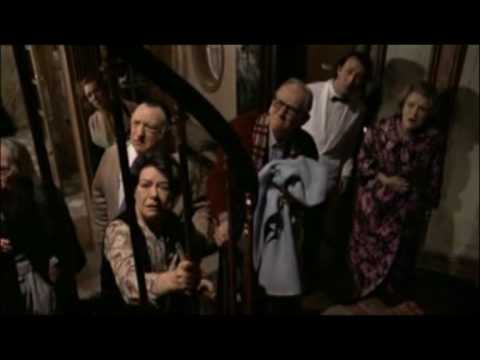
Above all, The Tenant self-consciously relishes the space of the abject. Polanski never refrains from exposing the distasteful, specifically all those substances that should not cross boundaries and must remain inside the body. This is most apparent in the hospital scene, where the dying stagnate in their bodily wastes, exposed to the public in their tortured last breath. Throughout the film we are also bombarded with images of filth and decay including a trail of rotting food Trelkovsky inadvertently leaves behind him when he carries the trash down the stairs. In fact, despite his best efforts to contain the foul objects while he is talking to building owner Monsieur Zy, orange peels begin slipping from the bag into his fingers and then hit the floor. In many ways, the waste mirrors his psychological descent and inability to keep a clean and proper body. Trelkovsky represents the abject resurging — the return of the repressed; he embodies the presence of the Other inside ourselves. His visions move us closer to experiencing the flourishing of the organic and a permanent state of otherness that manages to destroy social identity and norms. One scene best summarizes not only this concept, but also the efforts of the law to oppress otherness. During the funeral mass for Simone Choul, the law discloses its fear of corporeality and its sadistic tendency to delegitimize all that stands outside the normative. A frenzied priest angrily predicts the fate of Choul, who coincidentally “does not like men,” and those like her, identified as “the sick, the suffering, the dying.” He clamors:
It is evident here that the body threatens to defile the kingdom of law and thus destroy the possibility of salvation. However, note that the zealous sermon brings other issues into play that emphasize the public and political dimensions of the body, begging the question, “Who constitutes the abject and by what authority are these bodies eradicated, suppressed, silenced and subjected to the utmost damnation?”
III. Living on the Edge: The Condition of Bare Life
One of The Tenant‘s striking accomplishments is that it is driven not primarily by plot, but rather by the effects of the surroundings on the main character and his responses to these forms of violation on his person. In many ways he is the “foreign body,” the unwanted described by Kristeva. Katarzyna Marciniak reads The Tenant as “a cinematic narrative of exile” and a “critique of phobic nationalism” in which foreigners or those deemed to fall outside the norm are persecuted and expelled (Marciniak). To interpret this film as an extended critique of Polanski’s history, such as his childhood as a Jew in Nazi-controlled Poland or the tragedy of the Manson murders, is to neglect and devalue its deeper levels of meaning. Polanski has clearly expressed his reluctance to act as a social or political commentator, claiming his main interest lies in individual states of mind that evoke aspects of the human condition as a whole. He explains that in certain situations, such as moments of terror, people “live more intensely, and we’re able to learn more about who they really are” (Cronin). I would add that these situations reveal our shared vulnerabilities as sentient bodies and provide a certain introspection that derives from our position in the natural cycle of death and rebirth. While it is true that Trelkovsky’s Polish background is scoffed at in several scenes, and that both Choul and Trelkovsky becoming Choul represent forms of the abject — the homosexual and the cross-gendered body — the film does not read like a narrative about French xenophobia. Not only is the dialogue in English and the main cast international (American actor Melvyn Douglas as Monsieur Zy, American actress Shelley Winters as the concierge, Russian Lila Kedrova as Madame Gaderian, Polanski himself as Trelkovsky), but it does not try to capture the idiosyncrasies of French culture. It rather dwells on the concept of a more universal form of social intolerance. It thus represents a meditation on the presence of the Other within ourselves, and our instinctive reaction to simultaneously murder it because it signifies vulnerability, instability, and the unknown and to identify with it as part of our common bond of blood by which any social subject can be reduced to the condition of bare life. In this context, bare life refers to the status of a subject, stripped of his/her political rights and silenced, being systematically broken down to an existence of mere biological survival, just a step above death (Butler 67). Examples include political prisoners, victims of concentration camps, and minority groups deprived of their social rights. The abject in The Tenant closely matches this definition. As Marciniak points out, this state is “an unthinkable site of being neither fully alive nor yet dead” (Marciniak). Choul, at the beginning, and Trelkovsky, at the end, both incarnate this condition through their uncanny howling noise, a mixture of human and animal, genderless, completely unanswered and incomprehensible to the sphere of language and the law. Consequently, throughout the film we witness actions aimed at reducing Trelkovsky to this state of non-being, most notably the denial of identity and address. I believe Trelkovsky becomes marginalized not so much because he is a foreigner in France, but rather because he perceptibly carries the mark of the Other and therefore human vulnerability in his body and demeanor.


The body comes into the social sphere and is recognized as subject by means of address (Butler). The state of social being presents a charade in which certain players are allowed and others banned. In the eyes of society, Trelkovsky’s madness and worst crime stem from the fact that he exposes the frail boundaries erected by the law because these fail to contain him or, more closely, describe him. Something too uncanny for words represents him, engulfs him, renders him visibly threatening. He somehow cannot fit in. In the film, we notice his slight figure, usually addressed or handled by other characters proportionally gigantic in comparison. Stella, for instance, although female, has a stronger presence than Trelkovsky. In addition, he never manages to ooze much masculinity. His finely chiseled features and soft voice correspond to his malleability and his always absent presence. All about him borders on ambiguity, the non-identifiable and the yet unnamed. As a result, he is denied identity and finds himself exiled to the periphery, allowed to exist like a leper who must be shunned in order to avoid contamination. Because our vision fuses with his, we feel a sense of the frustration of occupying this space on several occasions. Not only is Trelkovsky the subject of a myriad of accusations to which he is not allowed to respond, but his voice is completely ignored. His identity continually merges with that of the dead woman Choul. When he asks for coffee and a pack of Gauloises Bleu at the cafe, he is given a cup of hot chocolate and a pack of Gitano Marlboro, what Madame Choul always had. Toward the end, when he fears he will turn into Choul and, for once, strongly asserts his desire for coffee, the waiter simply dismisses his request and tells him the espresso machine is broken. The same happens during his other interactions. Stella listens to him in boredom, but fails to understand. She pushes him along, bears with him, but very rarely do we feel he is of any importance in her epicurean lifestyle. In many ways, he is as unwanted and disposable as the scraps of food and cigarette butts that usually surround him.


IV. Identity and Re-“cognition”


As evidenced in The Tenant, film images can bring the repressed to life, reviving parts of ourselves we never knew existed. This medium appeals to the true sense of being because of the inundation of the spectators’ sensory apparatus that mimics real life. In it, we come to inhabit different bodies, transgress the borders separating imagination from reality, attain the impossible, and still yearn for more. Most importantly, it can remind us of our physicality, our vulnerability, and how these very two things constitute us as part of this world and relate us to other living organisms as well as to that which existed before and will continue to exist after we are gone. Here, we find ourselves at our most vulnerable. It happens at the precise moment we leave all social baggage behind and retire into the primary natural being — when we no longer fear the Other within us, but allow it to breathe. It is there that the essence of desire erupts, sweeps me, injures me until I can finally understand I am part of an organic cycle, always alive in its many births and deaths. Then the world opens up to me and I finally reach the pinnacle of my being.
Works Cited
Butler, Judith. Precarious Life: The Powers of Mourning and Violence. New York: Verso, 2004.
Cronin, Paul, ed. Roman Polanski Interviews. Jackson: University Press of Mississippi, 2005.
Euker, Jake. “Too Much.” Online. PopMatters Film Review. Internet. 12 December 2006. Availablehttp://popmatters.com/film/reviews/t/tenant.shtml.
Kristeva, Julia. Powers of Horror: An Essay on Abjection. New York: Columbia University Press, 1982.
Marciniak, Katarzyna. “Cinematic Exile: Performing the Foreign Body on Screen in Roman Polanski’sThe Tenant.” Camera Obscura 43.15.1 (2000): 1-43.

